淋巴系统
Section outline
-
What happens when your tonsils cause more problems than they solve?
::当你的扁桃体引起的问题 比它们解决的还多时会怎么样?Almost all of us have had a sore throat at some time. Maybe you had your tonsils out when you were younger? Why? Your tonsils are two lumps of tissue that work as germ fighters for your body. But sometimes germs like to hang out there, where they cause infections. In other words, your tonsils can cause more problems than they solve. So, you have them taken out.
::我们几乎都有喉咙痛的一段时间。也许你年轻的时候就把扁桃腺吐出来。为什么?你的扁桃腺是两块组织,可以作为人体的细菌斗士。但有时细菌会在那里挂,在那里造成感染。换句话说,你的扁桃腺可以造成更多的问题,而不能解决问题。所以,你把它们拿出来。Lymphatic System
::淋巴系统Like the immune systems of other vertebrates , the human immune system is adaptive. If manage to get through the body’s first two lines of defense, the third line of defense takes over. The third line of defense is referred to as the immune response . This defense is specific to a particular pathogen, and it allows the immune system to “remember” the pathogen after the infection is over. If the pathogen tries to invade the body again, the immune response against that pathogen will be much faster and stronger.
::与其他脊椎动物的免疫系统一样,人类免疫系统具有适应性。 如果能够通过身体前两条防线,第三条防线将接管。 第三条防线被称为免疫反应。 这一防线是针对特定病原体的,它允许免疫系统在感染结束后“记住”病原体。 如果病原体试图再次侵入身体,那么对病原体的免疫反应将更快、更强大。The immune response mainly involves the lymphatic system. The lymphatic system is a major part of the immune system. It produces leukocytes called lymphocytes . Lymphocytes are the key involved in the immune response. They recognize and help destroy particular pathogens in body fluids and cells. They also destroy certain cells.
::免疫反应主要涉及淋巴系统,淋巴系统是免疫系统的一个主要部分,它产生叫做淋巴细胞的白血球,淋巴细胞是免疫反应的关键,它们识别并帮助销毁人体液体和细胞中的特定病原体,还摧毁某些细胞。Structures of the Lymphatic System
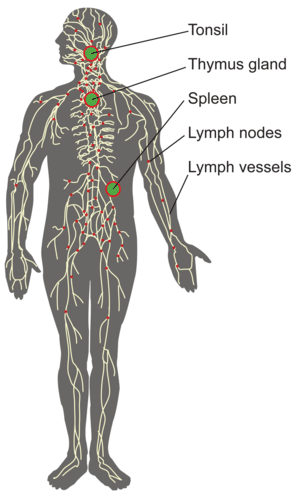
::B. 流体系统的结构结构Figure shows the structures of the lymphatic system. They include organs , lymph vessels , lymph , and lymph nodes . Organs of the lymphatic system are the bone marrow , thymus , spleen , and tonsils.
::图显示了淋巴系统的结构,包括器官、淋巴容器、淋巴和淋巴结。淋巴系统的器官是骨髓、胸腺、脾脏和。-
Bone marrow
is found inside many
. It produces lymphocytes.
::骨髓存在于许多体内,会产生淋巴细胞。 -
The
thymus
is located in the upper chest behind the breast bone. It stores and matures lymphocytes.
::胸腺位于胸骨后面的上胸,储存和成熟的淋巴细胞。 -
The
spleen
is in the upper abdomen. It filters pathogens and worn out
red blood cells
from the
, and then lymphocytes in the spleen destroy them.
::脾脏在上腹部,它过滤病原体,将红细胞从体内磨损,然后脾脏中的淋巴细胞将其摧毁。 -
The
tonsils
are located on either side of the
pharynx
in the throat. They trap pathogens, which are destroyed by lymphocytes in the tonsils.
::这些扁桃体位于喉咙的马林克斯两侧,它们捕捉病原体,这些病原体在里被淋巴细胞摧毁。
The lymphatic system consists of organs, vessels, and lymph.
::淋巴系统由器官、船只和淋巴组成。Lymphatic Vessels and Lymph
::淋巴船和淋巴船Lymphatic vessels make up a body-wide . The fluid they circulate is lymph. Lymph is a fluid that leaks out of capillaries into spaces between cells. As the lymph accumulates between cells, it diffuses into tiny lymphatic vessels. The lymph then moves through the lymphatic system from smaller to larger vessels. It finally drains back into the bloodstream in the chest. As lymph passes through the lymphatic vessels, pathogens are filtered out at small structures called lymph nodes (see Figure ). The filtered pathogens are destroyed by lymphocytes.
::淋巴动物的体外体外体外体外体外体外体外体外体外体外体外体外体外体外体外体外体外体外体外体外体外体外体外体外体外体外体外体外体外体外体外体外体外体外体外体外体外体外体外体外体外体外体外体外体外体外体外体外体外体外体外体外体外体外体外体外体外体外体外体外体外体外体外体外体外体外体外体外体外体外体外体外体外体外体外体外体外体外体外体外体外体外体外体外体外体外体外体外体外体外体外体外体外体外体外体外体外体外体外体外体外体外体外体外体外体外体外体外体外体外体外体外体外体外体外体外体外体外体外体外体外体外体外体外体外体外体外体外体外体外的体外体外体外体外体外体外体外体外体外体外体外体外体外体外体外体外体外体外体外体外体外体外体外体外体外体外体外体外体外体外体外体外体外体外体外体外体外体外体外体外体外体外体外体外体外体外体外体外体外体外体外体外体外体外体外体外体外体外体外体外体外体外体外体外体外体外体外体外体外体外体外体外体外体外体外体外体外体外体外体外体外体外体外体外体外体外体外体外体外体外体外体外体外体外体外体外体外体外体外体外体外体外体外体外体外体外体外体外体外体外体外体外体外体外体外体外体外体外体外体外体外体外Lymphocytes
::淋巴细胞The has as many as two trillion lymphocytes, and lymphocytes make up about 25% of all leukocytes. The majority of lymphocytes are found in the lymphatic system, where they are most likely to encounter pathogens. The rest are found in the blood. There are two major types of lymphocytes, called B cells and T cells . These cells get their names from the organs in which they mature. B cells mature in bone marrow, and T cells mature in the thymus. Both B and T cells recognize and respond to particular pathogens.
::淋巴细胞有多达2万亿个淋巴细胞,淋巴细胞约占所有白血球的25%。大多数淋巴细胞都存在于淋巴系统,最有可能发现病原体。其他的在血液中发现。有两大类淋巴细胞,称为B细胞和T细胞。这些细胞从它们成熟的器官中取出它们的名字。B细胞在骨髓中发育成熟,T细胞在胸腺中成熟。B细胞和T细胞都识别并回应特定的病原体。Antigen Recognition
::抗原识别B cells and T cells actually recognize and respond to antigens on pathogens. Antigens are molecules that the immune system recognizes as foreign to the body. Antigens are also found on cancer cells and the cells of transplanted organs. They trigger the immune system to react against the cells that carry them. This is why a transplanted organ may be rejected by the recipient’s immune system.
::B细胞和T细胞实际上识别和应对病原体上的抗原。 抗原是免疫系统认为与人体无关的分子。 在癌症细胞和移植器官细胞中也发现了抗原。它们触发免疫系统对携带这些细胞的细胞作出反应。这就是移植器官可能被接受者的免疫系统拒绝的原因。How do B and T cells recognize specific antigens? They have receptor molecules on their surface that bind only with particular antigens.
::B型和T型细胞如何识别特定抗原?它们表面有受体分子,只与特定抗原结合。As shown in Figure , the fit between an antigen and a matching receptor molecule is like a key in a lock.
::如图所示,抗原与匹配的受体分子的相容性就像锁中的钥匙。An antigen fits the matching receptor molecule like a key in a lock.
::抗原符合匹配的受体分子 就像锁里的钥匙一样Summary
::摘要-
The body’s third line of defense is the immune response. This involves the lymphatic system. This system filters pathogens from lymph and produces lymphocytes.
::人体的第三防线是免疫反应。 这涉及到淋巴系统。 该系统过滤淋巴病原体并产生淋巴细胞。 -
Lymphocytes are the key cells in the immune response. They are leukocytes that become activated by a particular antigen. There are two major type of lymphocytes: B cells and T cells.
::淋巴细胞是免疫反应中的关键细胞。它们是被特定抗原激活的白血球细胞。有两大类淋巴细胞:B细胞和T细胞。
Review
::回顾-
What is the lymphatic system?
::什么是淋巴系统? -
List three organs of the lymphatic system and their functions.
::列出淋巴系统的三个机关及其功能。 -
What are lymph nodes? What is their function?
::淋巴结是什么?它们的作用是什么? -
What are the two major types of lymphocytes?
::两大类淋巴细胞是什么? -
What are antigens, and how do lymphocytes “recognize” them?
::什么是抗原,淋巴细胞如何“承认”这些抗原?
-
Bone marrow
is found inside many
. It produces lymphocytes.