13.49 细胞调节反应
Section outline
-
Do cells really attack other cells?
::细胞真的会攻击其他细胞吗 ?They sure do. Depicted here is a group of T cells attacking a . When they can, the T cells search out and destroy “bad” cells.
::他们当然知道,这里最引人注意的是一组T型细胞攻击一个T型细胞。如果能够,T型细胞会搜索并摧毁“坏”细胞。Cell-Mediated Immune Response
::细胞调节免疫反应In addition to the , the other type of immune response is the cell-mediated immune response , which involves mainly T cells . It leads to the destruction of cells that are infected with . Some cancer cells are also destroyed in this way. There are several different types of T cells involved in a cell-mediated immune response, including helper, cytotoxic, and regulatory T cells .
::除此以外,另一种类型的免疫反应是细胞介质的免疫反应,这主要涉及T细胞,导致被感染的细胞被摧毁。有些癌症细胞也以这种方式被摧毁。在细胞介质的免疫反应中,有几种不同类型的T细胞,包括助手、细胞毒性和管制T细胞。T Cell Activation
::T 细胞激活All three types of T cells must be activated by an antigen before they can fight an infection or cancer. T cell activation is illustrated in Figure . It begins when a B cell or nonspecific leukocyte engulfs a virus and displays its antigens. When the T cell encounters the matching antigen on a leukocyte, it becomes activated. What happens next depends on which type of T cell it is.
::所有三种T型细胞都必须先用抗原来激活,然后才能对抗感染或癌症。T型细胞激活在图中说明。当B型细胞或非特定白血球吞没病毒并展示其抗原时,T型细胞就开始激活。当T型细胞在白血球上遇到匹配的抗原时,它就会被激活。接下来会发生什么取决于T型细胞是哪种类型。T cell activation requires another leukocyte to engulf a virus and display its antigen.
::T细胞激活需要另一种白血球来吞没病毒并展示其抗原。Helper T Cells
::帮助 T 单元格Helper T cells are like the “managers” of the immune response. They secrete cytokines , which activate or control the activities of other lymphocytes . Most helper T cells die out once a has been cleared from the body, but a few remain as memory cells . These memory cells are ready to produce large numbers of antigen-specific helper T cells like themselves if they are exposed to the same antigen in the future.
::帮助T细胞就像免疫反应的“管理者 ” 。 它们会将激活或控制其他淋巴细胞活动的细胞外科细胞分离出来。 大部分帮助T细胞一旦从身体中清除出来就会死亡,但有少数仍然作为记忆细胞存在。 这些记忆细胞准备产生大量的抗原特有T细胞,如果它们将来接触同样的抗原的话,它们也会像自己一样产生大量的抗原特有T细胞。Cytotoxic T Cells
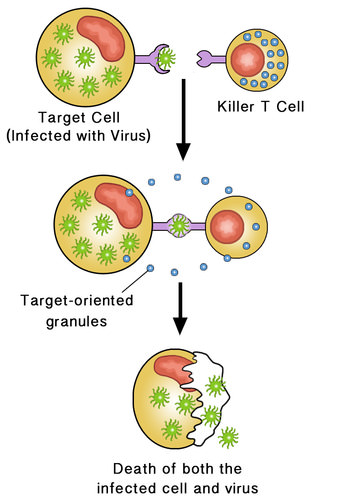
::Cyto毒性T细胞Cytotoxic T cells destroy virus-infected cells and some cancer cells. Once activated, a cytotoxic T cell divides rapidly and produces an “army” of cells identical to itself. These cells travel throughout the body “searching” for more cells to destroy. Figure shows how a cytotoxic T cell destroys a body cell infected with viruses. This T cell releases toxins that form pores in the membrane of the infected cell. This causes the cell to burst, destroying both the cell and the viruses inside it.
::细胞毒性T细胞会摧毁感染病毒的细胞和一些癌症细胞,一旦激活,细胞毒性T细胞会迅速分裂,产生与自己相同的细胞“军团”,这些细胞会“搜索”整个身体,以便摧毁更多的细胞。图示显示细胞毒性T细胞如何摧毁感染病毒的细胞。这个T细胞会释放毒素,形成受感染细胞的膜孔。这会导致细胞破裂,摧毁细胞和体内的病毒。A cytotoxic T cell releases toxins that destroy an infected body cell and the viruses it contains.
::细胞毒性T细胞释放毒素,摧毁受感染的身体细胞及其所含病毒。After an infection has been brought under control, most cytotoxic T cells die off. However, a few remain as memory cells. If the same pathogen enters the body again, the memory cells mount a rapid immune response. They quickly produce many copies of cytotoxic T cells specific to the antigen of that pathogen.
::在控制了感染后,大多数细胞毒性T细胞死亡,但少数细胞仍作为内存细胞存在。如果同样的病原体再次进入体内,内存细胞将产生快速的免疫反应。它们会很快产生许多该病原体抗原特有的细胞毒性T细胞。Regulatory T Cells
::监管T 单位Regulatory T cells are responsible for ending the cell-mediated immune response after an infection has been curbed. They also suppress T cells that mistakenly react against self antigens. What might happen if these T cells were not suppressed?
::监管T型细胞负责在抑制了感染后终止细胞中介的免疫反应,还抑制了对自我抗原产生错误反应的T型细胞。 如果不抑制T型细胞,会发生什么情况?Summary
::摘要-
Activated T cells destroy certain cancer cells and cells infected by viruses.
::激活的T型细胞摧毁了某些癌症细胞和受病毒感染的细胞。 -
Memory T cells remain in the body after the immune response and provide antigen-specific immunity to the virus.
::内存T细胞在免疫反应后留在体内,对病毒提供抗原特有免疫。
Review
::回顾-
Describe one way that cytotoxic T cells destroy cells infected with viruses.
::用一种方式描述细胞毒性T细胞摧毁感染病毒的细胞。 -
What are regulatory T cells?
::什么是监管T小组?
Resources
::资源 -
Activated T cells destroy certain cancer cells and cells infected by viruses.