13.54 艾滋病毒/艾滋病
Section outline
-
How long can a person live with HIV?
::感染艾滋病毒的人能活多久?Years ago, a diagnosis of an infection was a death sentence. Not today. With the proper medical treatment, an individual can live well over 10 or 20 or more productive years with an AIDS diagnosis. One of the most famous individuals with HIV is Earvin “Magic” Johnson, a retired professional basketball player. He was diagnosed in 1991. Over 20 years later, he is still doing well.
::几年前,对感染的诊断是死刑判决,而不是今天。通过适当的医疗治疗,一个人在艾滋病诊断下可以活10年或20年以上或更多年。最有名的艾滋病毒感染者之一是退休职业篮球运动员Earvin“Magic”Johnson。他于1991年被诊断为1991年。 20年后,他仍然表现良好。HIV and AIDS
::艾滋病毒/艾滋病Human immunodeficiency virus (HIV) is a that attacks the immune system . An example of HIV is shown in Figure . Many people infected with HIV eventually develop acquired immune deficiency syndrome (AIDS). This may not occur until many years after the virus first enters the body.
::人体免疫机能丧失病毒(艾滋病毒)是攻击免疫系统的一种病毒,图中显示了艾滋病毒的例子。许多感染艾滋病毒的人最终会发展出后天免疫机能丧失综合症(艾滋病),在病毒首次进入人体多年后才发生。HIV is a virus that attacks cells of the immune system.
::艾滋病毒是一种攻击免疫系统细胞的病毒。HIV Transmission
::艾滋病毒传播HIV is transmitted, or spread, through direct contact of mucous membranes or body fluids such as , semen , or breast milk. As shown in Figure , transmission of the virus can occur through sexual contact or the use of contaminated hypodermic needles . It can also be transmitted through an infected mother’s blood to her baby during late or birth or through breast milk after birth. In the past, HIV was also transmitted through blood transfusions. Because donated blood is now screened for HIV, the virus is no longer transmitted this way. HIV is not spread through saliva , touching or in swimming pools.
::艾滋病毒通过粘膜、精液或母乳等体液直接接触传播或传播,如图所示,病毒的传播可以通过性接触或使用受污染的皮下针头进行,也可以通过受感染母亲的血液在晚产期或通过产后或通过产后母乳传播,过去艾滋病毒也通过输血传播,由于捐赠的血液现在通过检测来检测艾滋病毒,病毒不再以这种方式传播,艾滋病毒不会通过唾液、触摸或游泳池传播。HIV may be transmitted in all of the ways shown here. Based on how HIV is transmitted, what can people do to protect themselves from becoming infected? What choices can they make to prevent infection?
::根据艾滋病毒的传播方式,人们可以做些什么来保护自己不受感染?他们可以作出什么选择来防止感染?HIV and the Immune System
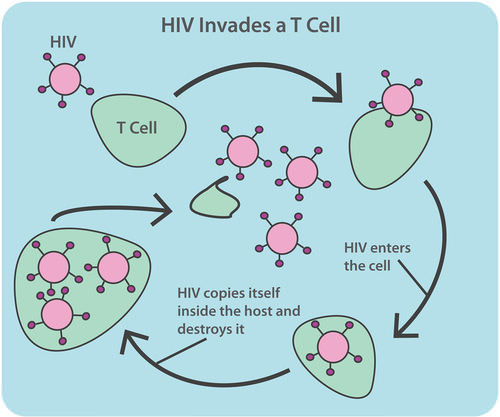
::艾滋病毒和免疫系统HIV infects and destroys helper T cells . As shown in Figure , the virus injects its own into a helper T cell and uses the T cell’s “machinery” to make copies of itself. In the process the T cell is destroyed, and the virus copies go on to infect other helper T cells.
::如图所示,病毒将自身注入一个帮助T细胞,并使用T细胞的“机器”复制自己。 在这一过程中,T细胞被摧毁,病毒复制又感染了其他帮助T细胞。This diagram shows how HIV infects and destroys T cells.
::这个图表显示了艾滋病毒感染和摧毁T细胞的方式。HIV is able to evade the immune system and keep destroying T cells . This occurs in two ways:
::艾滋病毒能够避开免疫系统,不断摧毁T细胞。-
The virus frequently mutates and changes its surface
antigens
. This prevents antigen-specific
lymphocytes
from developing that could destroy
infected with the virus.
::病毒经常变异和改变其表面抗原,防止特定抗原的淋巴细胞发育,从而可能摧毁受病毒感染的病毒。 -
The virus uses the plasma membranes of
host
cells to hide its own antigens. This prevents the host’s immune system from detecting the antigens and destroying infected cells.
::病毒利用宿主细胞的等离子膜隐藏自己的抗原。 这使得宿主的免疫系统无法检测抗原并摧毁受感染的细胞。
As time passes, the number of HIV copies keeps increasing, while the number of helper T cells keeps decreasing. The graph in Figure shows how the number of T cells typically declines over a period of many years following the initial HIV infection. As the number of T cells decreases, so does the ability of the immune system to defend the body. As a result, an HIV-infected person develops frequent infections. Medicines can slow down the virus but not get rid of it, so there is no cure at present for HIV infections or AIDS. There also is no vaccine to immunize people against HIV infection, but scientists are working to develop one.
::随着时间的流逝,艾滋病毒的复制件数量不断增加,而帮助T细胞的数量却在不断减少。图中的图表显示了T细胞的数量在最初感染艾滋病毒之后许多年中通常会如何下降。随着T细胞的数量减少,免疫系统保护身体的能力也随之下降。结果,艾滋病毒感染者会发展出频繁的感染。药物可以减缓病毒的速度,但不能消除它,因此目前没有治疗艾滋病毒感染或艾滋病的治疗方法。也没有疫苗对艾滋病毒感染者进行免疫,但科学家们正在努力开发一种疫苗。It typically takes several years after infection with HIV for the drop in T cells to cripple the immune system. What do you think explains the brief spike in T cells that occurs early in the HIV infection shown here?
::通常在感染了艾滋病毒之后几年,T细胞的衰落才能使免疫系统瘫痪。 你认为是什么解释T细胞在艾滋病毒感染初期出现的短暂猛增?AIDS
::艾滋病艾滋病AIDS is not a single disease but a set of diseases. It results from years of damage to the immune system by HIV. It occurs when helper T cells fall to a very low level and opportunistic diseases occur (see Figure ). Opportunistic diseases are infections and tumors that are rare except in people with . The diseases take advantage of the opportunity presented by people whose immune systems can’t fight back. Opportunistic diseases are usually the direct cause of death of people with AIDS.
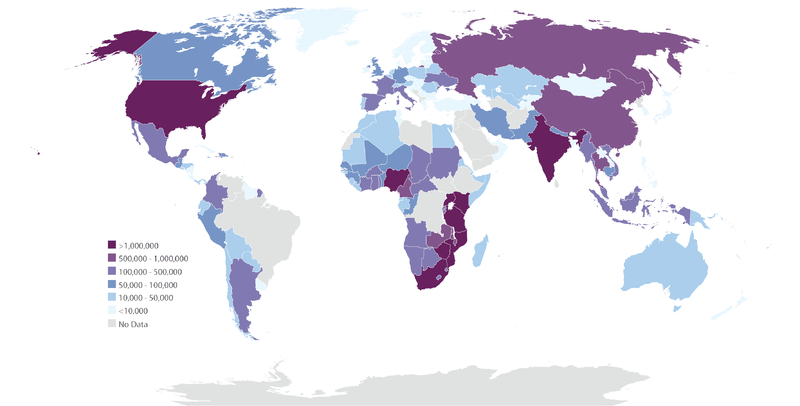
::艾滋病并不是一种单一的疾病,而是一系列疾病,是多年来艾滋病毒对免疫系统的伤害造成的,它发生在帮助T细胞降到非常低的水平和出现机会性疾病时(见图 ) 。 机会性疾病是感染和肿瘤,除了患者之外,是罕见的。 疾病利用了免疫系统无法抗争的人提供的机会。 机会性疾病通常是艾滋病患者死亡的直接原因。AIDS and HIV were first identified in 1981. Scientists think that the virus originally infected monkeys but then jumped to human , probably sometime during the early to mid-1900s. This most likely occurred in West Africa, but the virus soon spread around the world (see Figure ). Since then, HIV has killed more than 25 million people worldwide. The hardest hit countries are in Africa, where medicines to slow down the virus are least available. The worldwide economic toll of HIV and AIDS has also been enormous.
::1981年首次发现艾滋病和艾滋病毒。 科学家认为病毒最初感染了猴子,但后来又跳到人类身上,可能发生在19世纪初到19世纪中叶的某个时候。 最有可能发生在西非,但病毒很快蔓延到世界各地(见图 ) 。 自那时以来,艾滋病毒已使全世界超过2500万人丧生。 受影响最严重的国家是非洲国家,在那里,减缓病毒的药物供应最少。 全世界艾滋病毒和艾滋病造成的经济损失也非常巨大。This map shows the number of people in different countries with HIV infections and AIDS in 2008. The rate of spread of the infection is higher Africa than in the U.S., yet the U.S. has a relatively large number of people with HIV infections and AIDS. Why might there be more survivors with HIV infections and AIDS in the U.S. than in Africa?
::这张地图显示了2008年不同国家感染艾滋病毒和艾滋病的人数,非洲感染率高于美国,但美国感染艾滋病毒和艾滋病的人数却相对较多。 为什么美国感染艾滋病毒和艾滋病的幸存者比非洲还要多?HIV Research: Beyond the Vaccine
::艾滋病毒研究:疫苗之后Over the past 15 years, the number of people who die of AIDS each year in the United States has dropped by 70 percent. But AIDS remains a serious public health crisis among low-income African-Americans, particularly women. And in sub-Saharan Africa, the virus killed more than 1.6 million people in 2007 alone. Innovative research approaches could lead to new treatments and possibly a cure for AIDS. HIV/AIDS has been described as a disease of poverty. Individuals with poor access to health care are less likely to see a doctor early on in their HIV infection, and thus they may be more likely to transmit the infection. HIV is now the leading cause of death for African American women between 24 and 35 years old.
::在过去15年中,美国每年死于艾滋病的人数下降了70%,但艾滋病仍然是低收入非裔美国人,特别是妇女的严重公共卫生危机。仅在撒哈拉以南非洲,2007年就有超过160万人死于艾滋病。创新研究方法可以导致新的治疗,并可能治愈艾滋病。艾滋病毒/艾滋病被描述为一种贫困疾病。获得医疗保健机会差的个人在感染艾滋病毒的早期就不太可能看医生,因此他们可能更容易传染。艾滋病毒现在是24至35岁非裔美国妇女死亡的主要原因。For patients who have access to drugs , infection with the virus has ceased to be a death sentence. In 1995, combinations of drugs called highly active anti-retroviral therapy (HAART) were developed. For some patients, drugs can reduce the amount of virus to undetectable levels. But some amount of virus always hides in the body's immune cells and attacks again if the patient stops taking his or her medication. Researchers are working on developing a drug to wipe out this hidden virus, which could mean the end of AIDS.
::对于那些能够获得药物的病人来说,病毒感染不再是死刑。 1995年,研制了称为高度活跃抗逆转录病毒疗法(HAART)的药物组合。对于一些病人来说,药物可以将病毒数量降低到无法检测的水平。 但是,如果病人停止服用药物,某些病毒总是隐藏在身体的免疫细胞中,并且再次袭击。研究人员正在研制一种药物来消灭这种隐藏的病毒,这可能意味着艾滋病的终结。Further Reading
::继续阅读Summary
::摘要-
HIV is a virus that attacks cells of the immune system and eventually causes AIDS.
::艾滋病毒是一种病毒,它攻击免疫系统的细胞,最终导致艾滋病。 -
AIDS is the chief cause of immunodeficiency in the world today.
::艾滋病是当今世界免疫机能丧失的主要原因。
Review
::回顾-
What is the relationship between HIV and AIDS?
::艾滋病毒和艾滋病之间的关系是什么? -
Identify two ways that HIV can be transmitted.
::确定艾滋病毒可以传播的两个途径。 -
What cells are affected by HIV?
::哪些细胞受到艾滋病毒的影响? -
What happens to the number of HIV copies and the helper T cells over time in an infected individual?
::受感染者艾滋病毒副本和帮助T细胞的数量随时间推移会怎样? -
Draw a graph to show the progression of an untreated HIV infection. Include a line that shows how the number of HIV copies changes over time. Include another line that shows how the number of helper T cells changes over time.
::绘制图表以显示未经处理的艾滋病毒感染的演变情况。 包含一条线, 显示艾滋病毒复制数随时间变化。 包含一条线, 显示帮助者 T 细胞数随时间变化的情况 。 -
What are opportunistic diseases?
::什么是机会性疾病?
-
The virus frequently mutates and changes its surface
antigens
. This prevents antigen-specific
lymphocytes
from developing that could destroy
infected with the virus.