26.13 DNA和RNA
章节大纲
-
You can’t win them all!
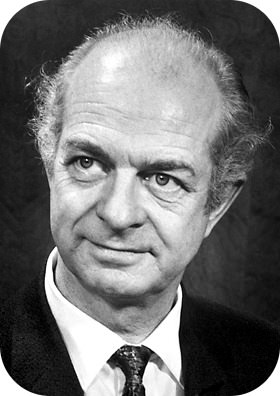
::你们不能全部赢!Linus Pauling was one of the greatest scientists of the twentieth century. A two-time Nobel Prize winner (in chemistry in 1954 and the peace prize in 1962). However, he didn’t always come in first. In the 1950s, there was a great deal of interest in the structure of DNA. Pauling spent some time on this puzzle, although he was primarily interested in . The inadequate amount of information he had led him to propose a DNA structure where the bases were on the outside and the phosphate groups were on the inside. It turns out that he was in error about this idea, but it certainly did not take away from his outstanding scientific reputation.
::莱纳斯·保林是二十世纪最伟大的科学家之一。他曾两次获得诺贝尔奖(1954年的化学奖和1962年的和平奖 ) 。然而,他并非始终首当其冲。 1950年代,对DNA结构有着极大的兴趣。 保罗在这个谜题上花费了一段时间,尽管他主要对这个谜题感兴趣。 他之所以提出DNA结构,其基础在外部,磷酸盐组在内部。结果显示,他对这个想法有错误,但肯定没有从他杰出的科学名声中消失。DNA and RNA
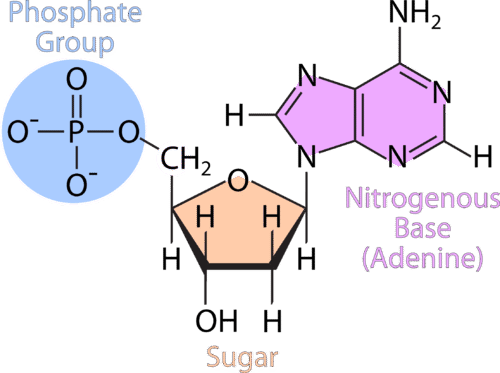
::DNA和RNAThe three parts of a DNA nucleotide are assembled as shown in Figure .
::DNA核糖核酸的三个部分如图6所示组装。Nucleotides are composed of a phosphate group, a sugar, and one of five different nitrogenous bases.
::核分裂剂由一个磷酸组、一个糖和一个五个不同的氮基组成。Every DNA and RNA polymer consists of multiple nucleotides strung together into extremely long chains. The only variation in each nucleotide is the identity of the nitrogenous . The figure above shows one example of a nitrogenous base, called adenine. There are only five different nitrogenous bases found in all . The four bases of DNA are adenine, thymine, cytosine, and guanine, abbreviated A, T, C, and G respectively. In RNA, the base thymine is not found and is instead replaced by a different base called uracil, abbreviated U. The other three bases are present in both DNA and RNA.
::每一个DNA和RNA聚合物都由多核素组成,并被串连到极长的链条中。每个核素的唯一不同之处是氮的特性。上图显示了氮基的一个例子,称为腺素。在全部中只发现了五个不同的氮基。DNA的四个基座分别是腺素、甲状腺、细胞素和guanine,缩缩写为A、T、C和G。在RNA中,底部的甲状腺没有找到,而是被另一个称为uracil、缩写为U的基座所取代。另外三个基座存在于DNA和RNA中。The specific structure of DNA proved elusive to scientists for many years. In 1953, James Watson and Francis Crick proposed that the structure of DNA consists of two side-by-side polynucleotide chains wrapped into the shape of a double helix . One aspect of this structure is that each nitrogenous base on one of the DNA strands must be paired up with another base on the opposite strand. Figure illustrates the base pairing. Each adenine base is always paired with a thymine, while each cytosine is paired with a guanine. The bases fit together perfectly from one strand to the other and are also held together by . The A-T pairing contains two hydrogen bonds, while the C-G pairing contains three hydrogen bonds. The ends of each strand are labeled either 3’ or 5’ based on a numbering of the deoxyribose sugar ring.
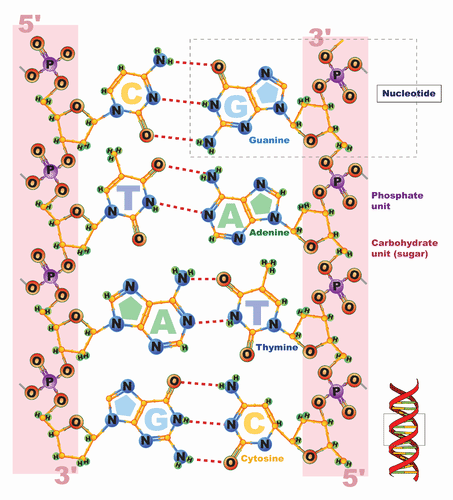
::1953年,詹姆斯·沃森(James Watson)和弗朗西斯·克里克(Francis Crick)提出DNA结构由两条平行的聚核酸链组成,被包在双螺旋形状中。这一结构的一个方面是DNA线上的每个氮基必须和另一根基对齐。图显示了基底配对情况。每根基与一根甲胺配对,每根基与一根谷氨配对。这些基底完全适合从一股到另一股,并同时由二根氢结在一起。A-T配对包含两根氢结,而C-G配对则包含三根氢结。每一根基底根据脱氧核糖圈的编号标定为3或5。Base pairing in DNA
::DNA基底配对The double helical structure of DNA is shown in Figure .
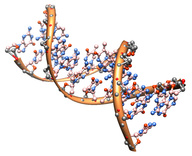
::图3显示了DNA的双螺旋结构。The DNA double helix
::DNA双螺旋Review
::回顾-
What four bases make up the DNA chain?
::DNA链上是什么四个基点? -
How are these bases held together?
::如何将这些基地放在一起? -
What is the resulting structure called?
::由此产生的结构叫什么来着?
-
What four bases make up the DNA chain?