2.1元素和化合物
章节大纲
-
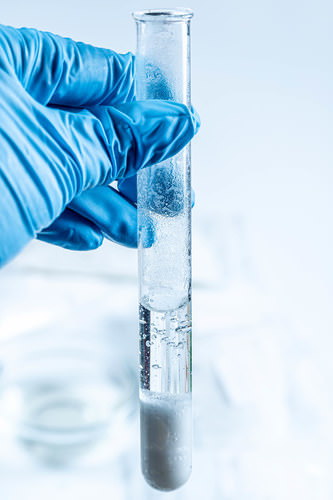
What's happening in this test tube?
::试管里发生了什么?The bubbles indicate that vapor is being formed, which lets you know that a chemical reaction is taking place. Many chemical reactions are going on constantly inside your body. In fact, there are probably thousands of chemical reactions occurring every second in every one of your cells . And as all living things are comprised of chemicals, understanding how chemicals work is essential to understanding how living things work.
::气泡表明蒸气正在形成, 使你知道化学反应正在发生。 许多化学反应正在你的身体里持续发生。 事实上, 每一个细胞里的每一秒都可能发生成千上万的化学反应。 由于所有生物都由化学物质组成, 了解化学物质是如何工作的对于理解生物是如何工作的至关重要。Chemicals of Life
::国际化学品生命组织The Elements
::要件If you pull a flower petal from a plant and break it in half, and then take that piece and break it in half again, and take the next piece and break it half, and so on, and so on, until you cannot even see the flower anymore, what do you think you will find? We know that the flower petal is made of cells , but what are cells made of? Scientists have broken down matter , or anything that takes up space and has mass—like a cell—into the smallest pieces that cannot be broken down anymore. Every physical object, including rocks, animals , flowers, and your body, are all made up of matter.
::如果你把花瓣从植物中拉出来,把它撕成两半, 然后把那个碎片再撕成两半, 然后拿下一个碎片,把它撕成两半,等等,等等, 直到你再也看不到花朵,你会发现什么? 我们知道花瓣是由细胞组成的,但是细胞是由什么组成的? 科学家们把物质分解了,或者任何东西, 吸收了空间, 并且将它像细胞一样, 聚集到无法再碎裂的最小的碎片中去。 每一个物理物体,包括岩石、动物、花和身体,都是由物质组成的。Matter is made up of a mixture of things called elements . Elements are substances that cannot be broken down into simpler substances. There are more than 100 known elements, and 92 occur naturally around us. The others have been made only in the laboratory.
::物质由混合物质组成,称为元素。元素是不能细分为更简单的物质的物质。已知元素超过100个,我们周围自然有92个。其他物质只在实验室里制造。Inside of elements, you will find identical atoms. An atom is the simplest and smallest particle of matter that still has chemical properties of the element. Atoms are the building block of all of the elements that make up the matter in your body or any other living or non-living thing. Atoms are so small that only the most powerful can see them.
::在元素中,您会发现相同的原子。原子是物质中最简单和最小的粒子,它仍然具有元素的化学特性。原子是构成您身体中物质或其他任何生物或非生物物质中物质的所有元素的构件。原子太小,只有最强大的才能看到它们。Atoms themselves are composed of even smaller particles, including positively charged protons , uncharged neutrons , and negatively charged electrons . Protons and neutrons are located in the center of the atom, or the , and the electrons move around the nucleus. How many protons an atom has determines what element it is. For example, hydrogen (H) has just one proton, helium (He) always has two protons ( Figure ), while sodium (Na) always has 11.
::原子本身由更小的粒子组成, 包括正充电质子、 未充电中子和负充电电子。 质子和中子位于原子的中心或原子的中心, 电子在核周围移动。 一个原子有多少质子决定它是什么元素。 例如, 氢( H) 只有一个质子, ( He) 总是有两个质子( Figure ) , 而钠( Na) 总是有 11 个质子( Figure ) 。All the atoms of a particular element have the exact same number of protons, and the number of protons is that element's atomic number . An atom usually has the same number of protons and electrons, but sometimes an atom may gain or lose an electron, giving the atom a positive or negative charge. These atoms are known as ions and are depicted with a "+" or "-" sign. Ions, such as H + , Na + , K + , or Cl - have significant biological roles.
::特定元素的所有原子的质子数量完全相同,质子的数量就是该元素的原子数。原子通常拥有相同数量的质子和电子,但有时原子可能会增减电子,给原子带来正负电荷。这些原子被称为离子,并用“+”或“-”符号描述。象 H+、 Na+、 K+ 或 Cl 这样的离子具有重要的生物作用。An atom of Helium (He) contains two positively charged protons (red), two uncharged neutrons (blue), and two negatively charged electrons (yellow). The Periodic Table
::定期表格In 1869, a Russian scientist named Dmitri Mendeleev created the periodic table , which is a way of organizing elements according to their unique characteristics, like atomic number, density, boiling point, and other values ( Figure ). Each element is represented by a one or two letter symbol. For example, H stands for hydrogen, and Au stands for gold. The vertical columns in the periodic table are known as groups, and elements in groups tend to have very similar properties. The table is also divided into rows, known as periods.
::1869年,俄罗斯一位名叫Dmitri Mendeleev的科学家创建了周期表,这是根据元素的独特性(如原子号、密度、沸点和其他值(图))来组织元素的一种方式,每个元素都用一两个字母符号表示。例如,H代表氢,Au代表金。周期表中的垂直柱子被称为组,而各组元素的特性也非常相似。表格还分为行,称为时段。The periodic table groups the elements based on their properties. The table begins with Hydrogen, atomic number 1. Chemical Reactions
::化学反应A molecule is any combination of two or more atoms. The oxygen in the air we breathe is two oxygen atoms connected by a chemical bond to form O 2 , or molecular oxygen. A carbon dioxide molecule is a combination of one carbon atom and two oxygen atoms, CO 2 . Because carbon dioxide includes two different elements, it is a compound as well as a molecule.
::分子是两个或两个以上原子的任何组合。 我们呼吸的空气中的氧是两个氧原子,通过化学结合连接成O2或分子氧。二氧化碳分子是一个碳原子和两个氧原子CO2的结合体。 因为二氧化碳包括两个不同的元素,它既是一个化合物,又是一个分子。A compound is any combination of two or more different elements. A compound has different properties from the elements that it contains. Elements and combinations of elements (compounds) make up all the many types of matter in the Universe. A chemical reaction is a process that breaks or forms the bonds between atoms of molecules and compounds. For example, two hydrogens and one oxygen bind together to form water, H 2 O. The molecules that come together to start a chemical reaction are the reactants . So hydrogen and oxygen are the reactants. The product is the end result of a reaction. In this example, water is the product.
::化合物是两个或两个以上不同元素的任何组合。 化合物与所含元素有不同特性。 元素的元素和元素组合( 化合物) 构成宇宙中所有类型的物质。 化学反应是一个过程, 打破分子原子和化合物之间的关联。 例如, 两个氢和一个氧结合到水中, H2O。 形成化学反应的分子是反应剂。 所以氢和氧是反应剂。 产品是反应的最终结果。 在这个例子中, 水是产物。Atoms also come together to form compounds much larger than water. It is some of these large compounds that come together to form the basis of the cell. So essentially, your cells are made out of compounds, which are made out of atoms.
::原子还聚集在一起形成比水大得多的化合物。有些大型化合物聚集在一起形成细胞的基础。所以基本上,你的细胞是由原子组成的化合物组成的。Summary
::摘要- Elements are substances that cannot be broken down into simpler substances with different properties.
::元素是指不能细分为性质不同的较简单的物质的物质。
- Elements have been organized by their properties to form the periodic table.
::元素按其特性排列组成周期表。
- Two or more atoms can combine to form a molecule.
::两个或两个以上的原子可以合并成一个分子。
- Molecules consisting of more than one element are called compounds.
::由多个元素组成的分子称为化合物。
- Reactants can combine through chemical reactions to form products.
::活性剂可以通过化学反应与形成产品的化学反应相结合。
Explore More
::探索更多Use the resource below to answer the following questions.
::使用以下资源回答下列问题。- Periodic table at
::表:截至2005年12月
- What is the atomic number of nitrogen? When and where was it identified? In what state of matter does nitrogen exist at room temperature?
::氮原子数是多少? 氮何时何地被确定为氮? 氮在室温下的状态如何?
- What is the atomic number of oxygen? When and where was it identified? In what state of matter does oxygen exist at room temperature?
::氧原子数是多少? 何时何地被识别? 室温时氧在何种状态下存在?
- What is the atomic number of carbon? When and where was it identified? In what state of matter does it exist at room temperature?
::碳原子数是多少? 何时和在哪里查明的? 室温是处于什么状态?
- What is the atomic number of phosphorus? From what was phosphorus originally isolated? In what state of matter does it exist at room temperature?
::磷的原子数是多少?磷最初从什么分离出来的?在什么状态下,在室温下是存在的?
Review
::回顾- What is an element?
::什么是要素?
- What is the difference between the terms molecule and compound?
::分子和化合物之间有什么区别?
- Describe the composition of an atom.
::描述原子的构成。
- Who is credited with developing the periodic table?
::谁负责编制定期表格?
- Elements are substances that cannot be broken down into simpler substances with different properties.